Looking to offload Plex from my gaming PC
I am looking to basically just transition to a small time, forever on, server to support my growing Plex footprint. I don’t need anything top of the line, and I’ve already crimped my lines to the room.
What’s the most cost effective way to go about this? Figured i would come to the pros.
Thanks!
#selfhosted
919 posts · Last used 1h
[AIP] Oxynote: An open‑source technical wiki connected to the systems it describes
Is POP email still a thing?
I’m tempted to move to email with my own domain, but don’t really care about the server side of things, I guess I’m following the line that self hosted email is not easy to do, and not sure how reliable I can make my servers.
The other option is to have some other system do the email hosting, and if it is through my domain then there should be no issues with moving around if needed. Hosting all the email archive isn’t really needed either, I’d be fine self hosting or storing the archive.
Is there a set up where some remote service handles email exchange, and you just sync with it eg through POP style interfaces? Id actually prefer if my own server was doing the sync rather than a desktop running Thunderbird etc, that way it is kind of self hosted but also robust to down time. What’s the best practice along these lines?
Time to start over...Thoughts on Umbrel OS?
UPDATE 11/5: Thank you to everyone who has commented & advised me! I found thishttps://selfhostable.dev/…/casaos-vs-umbrel-v… Which seems relatively sane, also thanks for those who pointed me to TechDadLife. I’m skipping Umbrel (just toooooo simple…) and going with Yunohost or reCasaOS for a more supported, up-to-date GUI front end. Cheers!
TL:DR - have you used UmbralOS on a non-umbral device? Is it pretty straightforward? Reliable? Easy to use for a simple media server?
THE TL:
SO my mini-pc’s M.2 SSD shit the bed, and I’m essentially forced to rebuild my media server from backups, etc. I keep my actual media on USB external drives, and backup my configs/YAML regularly, so not the end of the world. I’ve put in a new SSD and ready to restart… but as they say, each problem is also an opportunity, and I’m considering switching the structure/interface of the server.
Instead of pure, headless CLI ubuntu server, I previously used CasaOS, as, at the time, I was new to hosting, and other users in my household are absolutely allergic to CLI and pretty much always will be. CasaOS is nice because the Debian CLI is there for me if I need it, but running on top is an “Okay” GUI that has familiar things like “apps” and folders with folder structures. Even though I’m much more experienced than I was, say, a year ago, I still think I’d rather not do “pure” CLI docker compose. I only need a couple, simple services, that are easier for other household members to interact with independently if it has a GUI. If you think there’s a compelling reason I should change my mind on that, tell me why.
CasaOS over the past year ish has started to feel very much like abandonware, however, as they’ve moved to ZimaOS (which is waaay more than we need, I’m not running a RAID or trying to set up 20+self-hosted services…Does anyone have experience with UmbralOS (especially on NON-Umbral hardware, and with USB external HDD storage) It’s for a simple media & file hosting experience via Jellyfin, primarily.
We’re running an ARR stack, Jellyseer & Jellyfin with Nextcloud for photos & documents. My mini pc is a GEEKOM Air12 LITE which is not particularly beefy on specs… though I’m going to add another 8 gb of RAM to it when I upgrade. Any thoughts/advice are so greatly appreciated. Thank you!

Enabling the Firewall in my Proxmox Cluster

It's self hosting Sunday! What's up?
Let’s do another round of this. What’s going on on your servers, any cool things? How’d the recent CVE flood tangent you and did it change how you see/do stuff?
[CBH] OpenFile: a static, self hostable file toolbox (PDF, images, video, OCR) with no backend
OpenFile is a static React and Vite app, so there is no backend to run and nothing to keep patched. Every tool uses WebAssembly or Web Workers in the visitor’s browser. The repo has a Dockerfile and it also works from any static host. I built it so I could stop trusting upload based converter sites. Live demo: openfile-studio.vercel.app . I am the author. I would like feedback on the self hosting setup and which tools are missing for your homelab workflow.
What should I replace the GTX 1080s in my server with?
As part of my Homelab, I have TrueNAS Community Edition running in a big case with a bunch of Frankenstein parts including two GTX 1080s. TrueNAS recently phased out support for these older cards and I’ve been having to go through and manually install working drivers, which seem to have gotten overwritten on the last update anyway. Since I’m not actually using anything for video output (and have onboard HDMI if needed). One of the cards I am passing through to a VM (where it has no problem being recognized and used). The other card was used by Truenas for my apps.
Do you have any recommendations for hardware to accelerate tasks like Immich, Jellfin transcoding, media fingerprinting for metadata, OCR on bulk-uploaded pdfs etc.?
I was never really a hardware guy, especially when it comes to self-hosting and servers.
I don’t want to play games on my server.
I don’t want to empty my accounts to put a 5090 TI in a server.
The above tasks are too slow on CPU alone, so I have to put something in it.
I could keep running the 1080s with manually installed drivers, but it’s a PITA and I wouldn’t mind not doing that.
Are there reasonable options that can take up the workload, but come in at a decent price point? I know with a server, I don’t necessarily have to run the same stuff as gamers. Are there options outside of the typical NVIDIA and AMD gaming linups that would work for my purpose, perhaps acquirable via FB marketplace, Craigslist, etc.? Does your server have video acceleration and, if so, what hardware are you using?
I appreciate any guidance the community can give me.

Boosted by @welcome@friends.deko.cloud
Hi Mastodon! I'm Ahmet, a developer from Türkiye.
The operating system vulnerabilities of the past months made me want
to build a safer Linux distribution and raise awareness about
hardening. That became SedirOS, a hardened Debian-based server distro.
1.0 shipped this week.
I'm here to get feedback and find out what's still missing.
#introduction #linux #debian #infosec #selfhosted
This is not creepy, but I enjoy handing candy out to children
Halloween is the one night of the year that I get to hand candy out to children, who I do not know and it is socially acceptable. So tonight is the night I get to do it!
I have also gotten into the hobby of Homelabbing, so it is Halloween and I could not figure out why my Ring light was not staying on. Home Assistant could not turn it on nothing, I was spinning the gears in my head what was not working? I looked at it and I saw the little blue light flashing, I thought that was weird why is it flashing. I found my phone and went into the Ring app and it was saying it could not find the light? Then I thought well I will just need to maybe turn it off and on again, nope the blue light just kept flashing. So than I thought I would just reset it and make it join wifi again, when I turned it on into pairing mode I remembered that I had yet to give it access to my IoT wifi network. So it had been working on its schedule and motion detection with no way of telling me anything and I did not realize this over sight until today. So always remember that you need to get everything to rejoin your wifi if you make changes, like adding a IoT subnet!
On top of that I was panicking that I could not find the wifi code in the stupid theme I have on OpenWRT, luckily there is a command for that “cat /etc/config/wireless” entered that and I could get the password easy peasy.
Mounting Truenas datsets on Proxmox
I have Truenas Scale as a file repository. Then Proxmox on seperate machine but same network.
On Proxmox I have VM withe several services. Some of these store several GBs of data so i would lime to mount datasets to Proxmox. What is the best wat of doing this? Mount a single nfs share to proxmox and the mount this share in the vm or should i mount the truenas daraset directly in the vm? The latter semms simpler? My.main cincern is avoiding disasters on services, vm and proxmox il nas goes offline for whatever reason. Is there a way to deal with this risk?

Boosted by @welcome@friends.deko.cloud
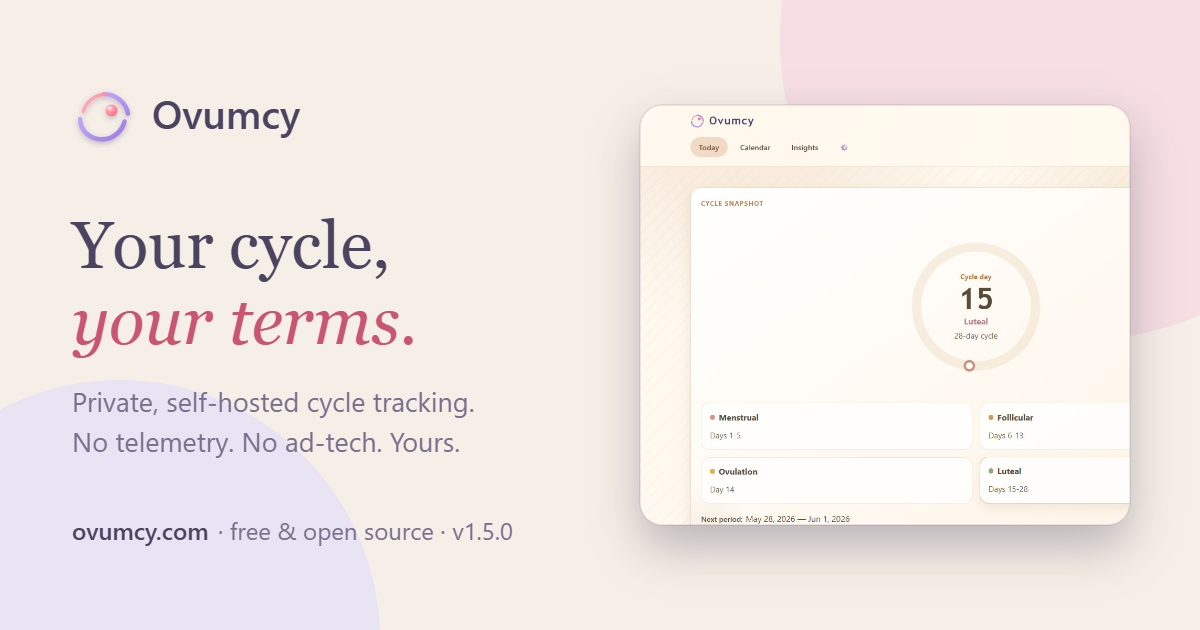
Hi, fediverse! We're Ovumcy, a menstrual cycle tracker you run yourself.
Your period dates, symptoms and fertile-window estimates stay on your own server, not in someone else's cloud. One Go binary or container, SQLite or PostgreSQL, no vendor account, no analytics, no telemetry, CSV and JSON export anytime. Open source, AGPL-3.0.
Predictions are estimates, not medical advice.
https://ovumcy.com
https://github.com/ovumcy/ovumcy-web
#introduction #selfhosted #privacy #FOSS #periodtracker

Linux Kernel TCP Flaw With 9.8 CVSS Score Affects Ubuntu, Red Hat and Other Distributions
Every Go application since 1.24 will activate MPTCP on their sockets by default.
And I’ve read that this includes Syncthing, which is why I’m posting this here

Help an idiot protect his homelab and few services exposed to the internet.
Hi all,
I am running proxmox on a mini PC with a handful of services in my stack. I also run NPM in an LXC to reach my services through my domain name (service.domain.tld).
For my Arr related stuff, I use Usenet, and everything runs through a VPN.
I have three services which are public. Jellyfin, Seer and BookOrbit (for syncing Kobos).
Currently I have no security besides the built in login managers from the services, but I am considering setting up Authentik. I know I’m asking for trouble with my current set up.
I have elderly and extremely tech averse family members who live in two countries other than me, so tech support can be a challenge.
A lot of people suggest running a VPN, but it would be difficult for my family and I don’t know how to make it work syncing our Kobos with BookOrbit.
I’ve also seen some posts about tunneling to a VPS somewhere and users can connect to the VPS without a VPN.
I feel this question has been asked several times, and I tried searching here and on the internet in general, but my knowledge is not good enough to use the right terms and to get something that is idiot proof.
Any suggestions on best practices or links to guides you recommend would be much appreciated. Also, what EU based affordable VPS would you recommend?

It's #FairtradeMusicFriday! Here's a new submission thread for November.
Submit your own release or someone else's, it can be by #FediMusicians or not.
It should be hosted on an open platform like #Faircamp, #JamCoop, #Mirlo or #SelfHosted, or on a platform fair to artists like #Bandcamp or #Subvert. As long as it is by an #IndieArtist - it doesn't even need to be new.
Just make a direct public comment (with a link & description) to this post and it will appear at https://isitfairtrademusicfri.day automagically!
Buying or boosting will make an artist's day 💙



How much pain should I expect upgrading my server from Debian 12 to 13?
The insidious urge to fix what ain’t broke has arisen. I’ll probably follow the official documentation, unless someone has a better suggestion.
I’m not running anything unusual and I haven’t done much, if any, “customization”. I update packages maybe a couple of times a week, so they’re current.
Should I go ahead and put myself through this now, or wait until support is dropped and I’m forced?
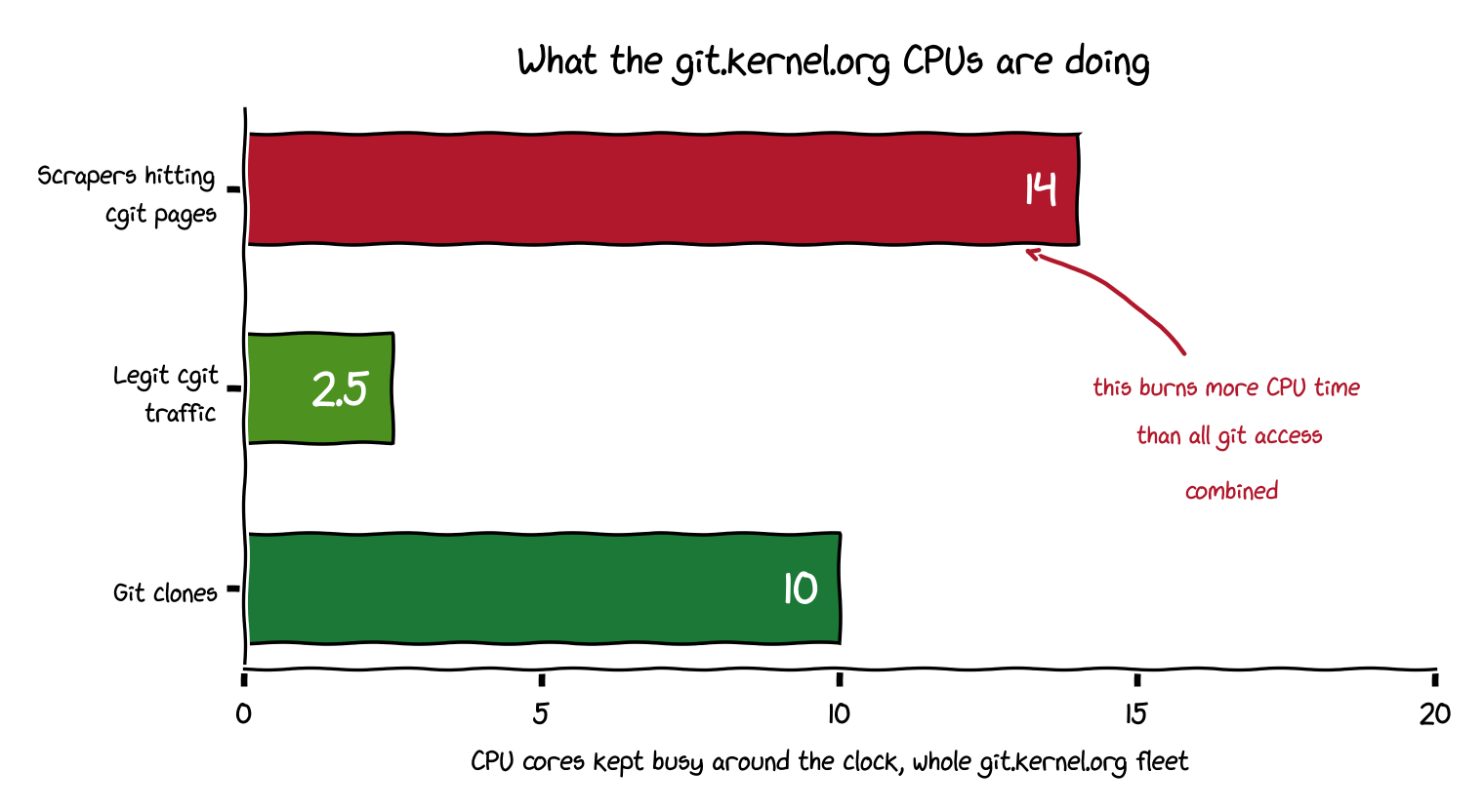
[AIT] Creepy crawlies (AI crawlers on git.kernel.org)
Cross posted from: lemmy.world/post/53750210
Looking for a tool for browsing contents of unmounted cold storage
Hello everyone, I’m in the process of setting up long term storage of a large amount of media files for my family. Since this is stuff that’s rarely accessed, I don’t need it to be always fully available, and I want to limit the actual transfer of files to a specific schedule.
Since knowing what’s already in storage is kinda non-trivial, are there any tools out there that allow me to browse which files are in cold storage, without the actual drives being attached / mounted? So only info like file location, name, metadata, perhaps icon, etc.
The transfer part I can manage to automate, as I can think of a few ways of allowing my users to “stage” pulling and pushing info from and to cold storage, and having the transfers be done on a fixed schedule like every two weeks or something.
Obviously self-hosted, open source stuff that’s not vibecoded is preferred.
Thanks in advance!
[AIP] Stalwart v1.0: The Fastest Mail Server on the Planet


Is webmin safe to have accesible over the web
As the title says ive started running webmin. And i wanna know if its safe for me to reverse proxy (with 2fa) or should i just use tailscale or ssh to access it.